

Rocket League
Rocket League Unreal Engine 6 (UE6): Release Date, Physics & Everything We Know
Rocket League is officially moving to Unreal Engine 6. Here’s what UE6 could mean for physics, graphics, performance, RLCS, Steam Deck support, and release timing.

Rocket League Unreal Engine 6 (UE6): Release Date, Physics & Everything We Know
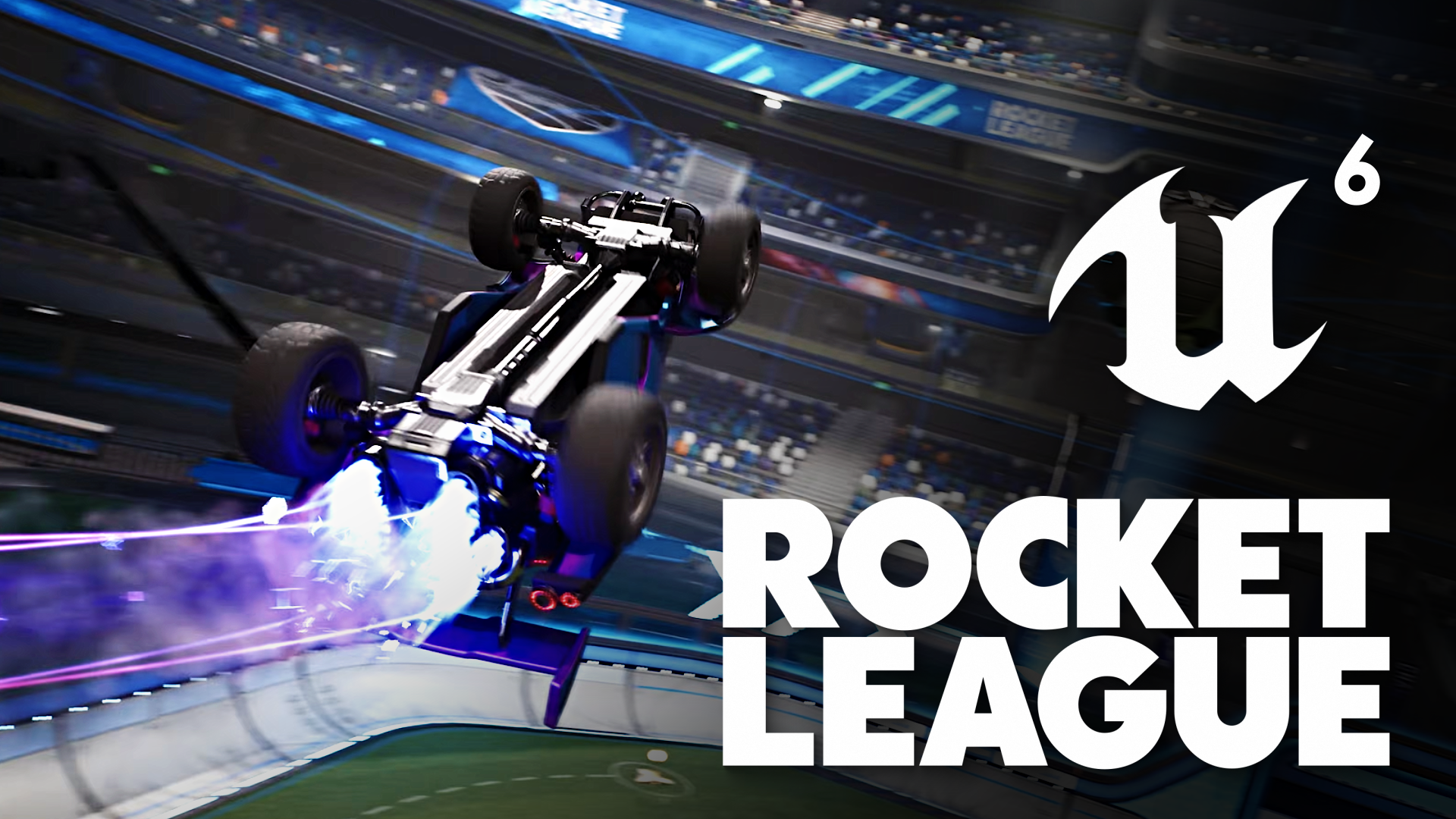
Rocket League is officially moving to Unreal Engine 6 (UE6), marking the game's first engine transition since launching in 2015.
The announcement immediately raised questions across the community: Will Rocket League physics change? Will ranks and cosmetics carry over? Will older PCs still run the game? And when will Rocket League UE6 actually release?
While Epic Games and Psyonix haven’t shared full technical details yet, we can make informed predictions based on Tim Sweeney’s public comments, Unreal Fest presentations, and how previous Unreal Engine migrations have worked.
TL;DR
- Officially confirmed at RLCS Paris Major, 24 May 2026: Rocket League is moving from Unreal Engine 3 to Unreal Engine 6, skipping UE5 entirely.
- All footage shown was real-time in-engine, not pre-rendered cinematic, explicitly stated in the trailer.
- Physics are publicly committed to remain identical. Same ball, same hitboxes, same kickoff, same MMR.
- No release date announced. Tim Sweeney's own framing puts UE6 preview builds 2-3 years out → realistic Rocket League UE6 deployment is late 2028 to 2029.
- Sideswipe is NOT discontinued. It moved to the Epic Games Store mobile in August 2024 and is currently on Season 17+. Frequently misreported.
- Next likely info beat: Unreal Fest Chicago (June 2026) for deeper UE6 technical reveals.
The video below breaks down everything we know about Rocket League's move to Unreal Engine 6 in about 60 seconds.
What Has Psyonix Actually Confirmed?
Only these points are confirmed. Everything else in commentary (this post included) is informed speculation:
- Rocket League is moving from Unreal Engine 3 to Unreal Engine 6. UE5 is being skipped.
- The teaser footage was real Rocket League, in-engine, running on UE6. The trailer text reads "captured real-time in game" -a deliberate qualifier given how often game reveals lean on pre-rendered cinematics.
- The physics will remain identical. This is a public commitment to the competitive community.
- A verse://rocketleague.com URL flashed in the trailer, signalling tight integration with Epic's Verse-powered ecosystem (Fortnite, UEFN, future Epic-published projects).
- Rocket League is being positioned as a core part of Epic's unified gaming ecosystem, not just a maintained acquired property.
Everything else below is projection from Tim Sweeney's public UE6 framing and the wider Epic roadmap.
Why Skip UE5 Entirely?
This was the genuinely surprising part of the reveal -even some pros briefed in advance didn't expect UE5 to be skipped. The likely reasoning:
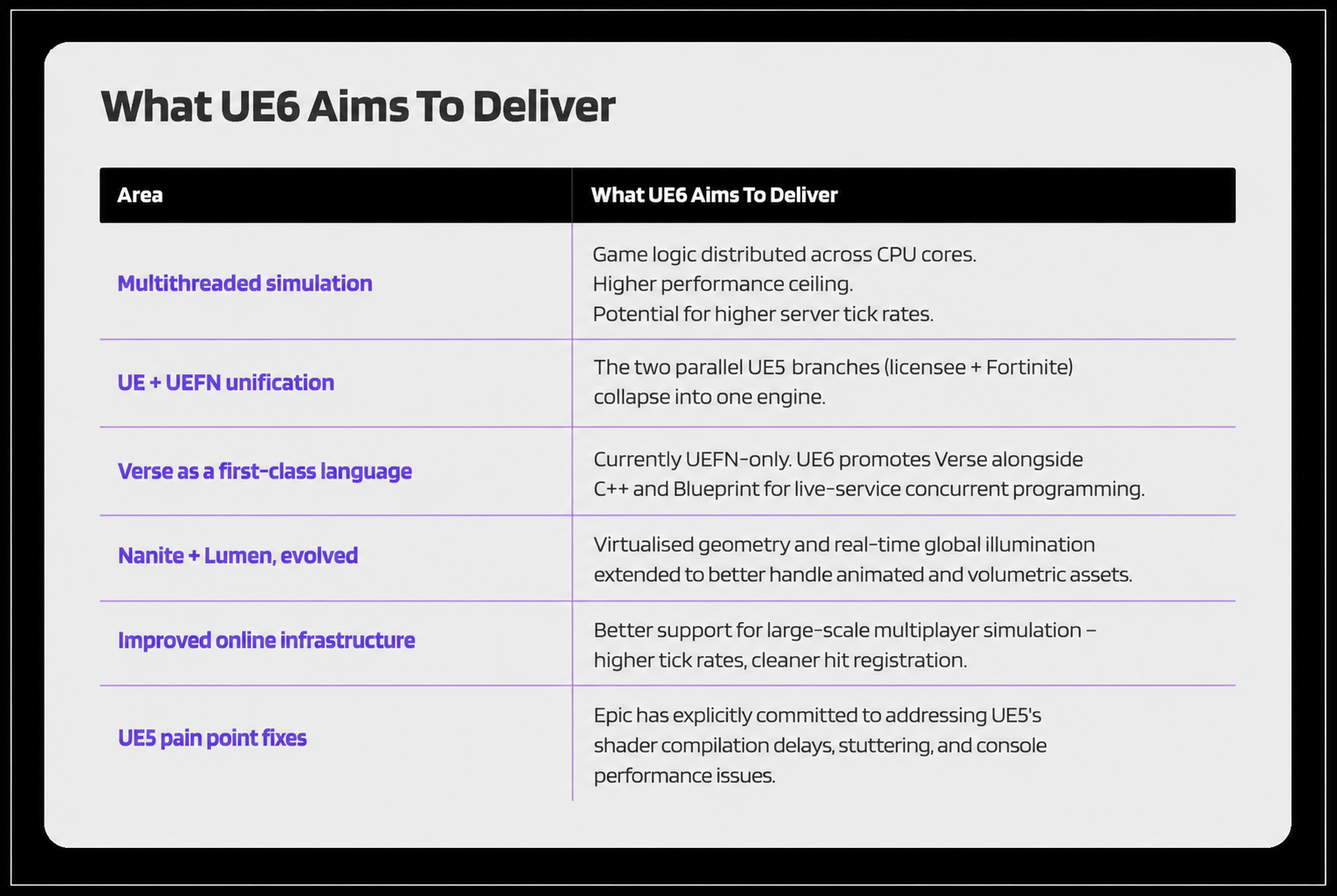
- UE5 has a documented reputation problem. Shader compilation stutters, inconsistent console frame rates, single-threaded simulation CPU bottlenecks. For a competitive title running at high refresh rates where milliseconds matter, migrating to UE5 and then migrating again later would be a worse outcome than waiting.
- UE6 is built around multithreaded simulation -distributing game logic, physics, AI, and animation across multiple CPU cores rather than a single one. Sweeney's framing: "If you have a 16-core CPU, we're using one core for game simulation [in UE5]."
- Strategic alignment. Epic is positioning UE6 as the engine developers want to be on for the next console generation. Using Rocket League -a well-understood codebase with a relatively contained architecture -as the first public showcase is a sensible test bed before scaling to Fortnite.
Why has Rocket League been on UE3 in 2026? Because Psyonix built the physics engine directly into UE3. The hitboxes, the ball-car interaction, the aerials -all of it is welded to the engine. Moving that without breaking the feel is the hard part. It's the same reason the 2021 UE5 migration plan quietly disappeared.
What Is Unreal Engine 6?
Epic hasn't published a full UE6 technical spec yet. What follows is based on Tim Sweeney's appearances (Lex Fridman Podcast #467, April 2025; Unreal Fest follow-ups) and early reporting from the Paris reveal. Directional, not confirmed spec:
Unreal Fest Chicago (June 2026) is the next likely venue for a real feature breakdown.
What Probably Doesn't Change
Psyonix has no commercial incentive to break the parts of the game players actually care about. Expect these to remain identical:
- Ball physics -explicitly committed to
- Hitbox dimensions (Octane, Dominus, Fennec, etc.)
- Kickoff structure and field dimensions
- MMR, ranked structure, ranked seasons
- RLCS competitive ruleset
Esports orgs with active RLCS rosters (FaZe, G2, Cloud9, Karmine Corp) are watching the physics promise closely. It will need to survive an actual public playtest before the community trusts it.
What Probably Disrupts Things
Hardware
Minimum spec is going up. The exact cutoff hasn't been published, but UE6 is not going to run on 2015-era hardware the way current Rocket League does. Steam Deck and low-end PC players are likely to feel this hardest.
Linux, Proton, and the EAC Question
Rocket League on Linux has been complicated since EAC went live in April 2026. UE6 plus a tighter Epic launcher wrapper could go either way -proper Proton support from day one, or further deprioritisation. Watch closely.
Console Support
PS5 and Xbox Series X|S are essentially certain. Switch 1 is the open question -UE6's hardware ambitions and Switch 1's silicon are not friends. Switch 2 is more plausible but unconfirmed. Decision likely depends on whether Psyonix maintains a UE3 build for older platforms or hard-cuts.
Sideswipe and Mobile -Important correction
⚠️ Sideswipe was NOT sunsetted in 2023. This is a common misconception.
The actual timeline:
- November 2021: Sideswipe launches on Google Play and the Apple App Store.
- August 2024 (Season 17 onward): Sideswipe moves from the Play Store and App Store to the mobile Epic Games Store. It remains on Android worldwide via EGS mobile, and on iOS in the EU via EGS mobile (EU DMA-permitted sideloading). The original app store listings were removed on 23 August 2024.
- Long-Time Fan title awarded to anyone who played before August 2024 as a thank-you.
- Currently: Sideswipe is still in active development on EGS mobile. Receiving new seasons, balance changes, and cosmetics.
The migration was an Epic ecosystem play, not a sunset. Sideswipe is a separate codebase from main-line Rocket League (not Unreal at all -it's a bespoke mobile build), so UE6 doesn't apply to it directly. But the assertion that Sideswipe is dead is factually incorrect and should not be in a published explainer.

RLCS Logistics
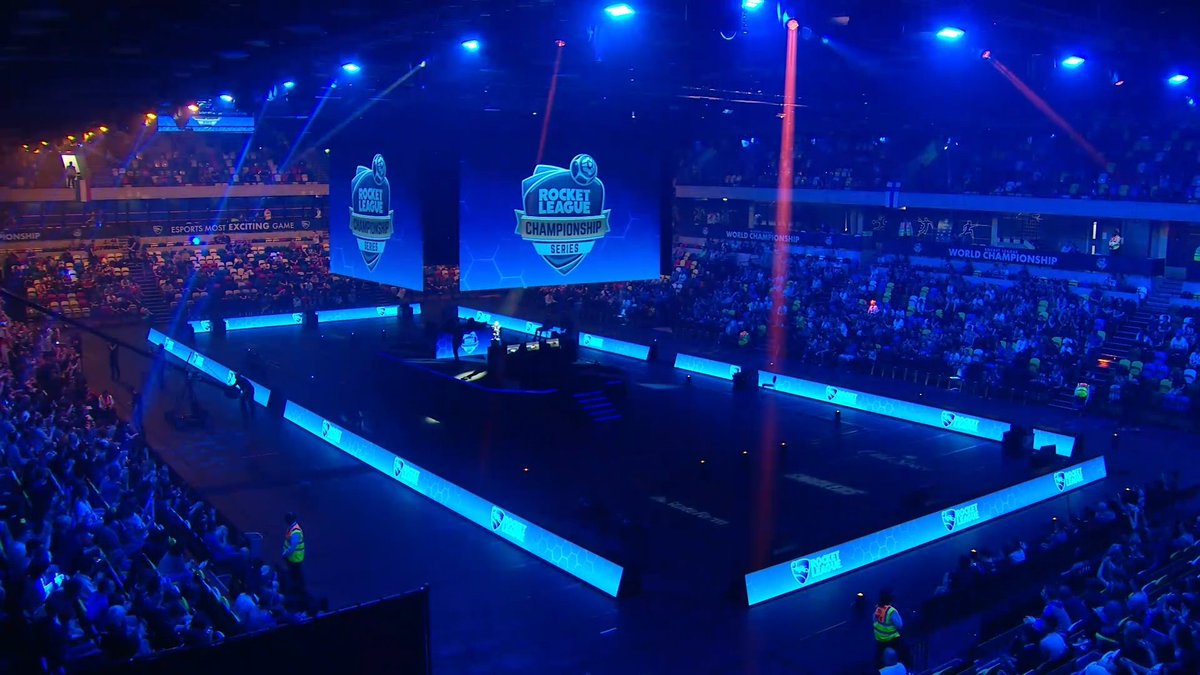
UE6 Rocket League will need a long PTR cycle. RLCS is a year-round circuit with majors, regionals, and a world championship. The transition can't happen mid-season without breaking competitive integrity. The cleanest answer is a season-break PTR with the next RLCS season starting on UE6 -and that requires UE6 Rocket League to be ready on Psyonix's timeline, not Epic's broader UE6 timeline.
Rocket League UE6 Release Date Predictions
Not soon. Anyone telling you otherwise is hyping.
- Tim Sweeney's May 2025 framing put UE6 preview builds 2–3 years out for developers.
- That puts a production-ready engine at roughly 2028 at the earliest.
- For Rocket League specifically:
- Late 2027 at the absolute earliest, assuming Psyonix is Epic's internal testbed.
- 2028 PTR is more realistic.
- Full live-service migration in 2028 or 2029 is the most likely outcome.
- It's also not yet clear whether UE6 Rocket League is a major update, an entirely new title, or something in between. Some current platforms (notably Switch 1) may not be able to run a UE6 build at all.
Practical advice: plan for the Rocket League you have today. Grind the mechanics that translate. The engine will arrive when it arrives. Our Rocket League Mechanics by Rank post has the specifics on which mechanics are worth your time at each rank.

Content Creator and Community Reaction
The reveal has been the biggest Rocket League news in years. A snapshot of the conversation:
- Mainstream coverage (Gematsu, TheGamer, BLAST, Operation Sports) framed it as a long-overdue but conservative upgrade -visual and infrastructural, not a gameplay rewrite.
- Pro and creator reactions have leaned cautiously positive, with two recurring themes:
- Physics anxiety. Years of muscle memory are on the line. Pros will not trust the "identical physics" promise until they've played a public build.
- Hardware anxiety. Quoted reaction from community caster Bobo23: "I don't even know if I'll be able to play it on my old computer." Reflects a real concern for the slice of the community on aging hardware.
- Big creators (SunlessKhan, Wayton Pilkin, Lethamyr, Jon Sandman, Thanovic) have all covered the reveal. Common talking points across their videos:
- Genuine surprise at skipping UE5
- Cautious excitement about higher server tick rates
- Scepticism about timeline (most are echoing 2028+)
- Concern for low-spec and Steam Deck players
- Esports organisations (FaZe, G2, Cloud9, Karmine Corp) are publicly aligned with the upgrade but quietly tracking the physics commitment.
Rocket League Inside Epic's Ecosystem
One detail from the Paris trailer drove a lot of discussion: a brief animation placing Rocket League alongside Fortnite, the Disney partnership, and Epic's broader project slate. The implication is that Rocket League is being repositioned as a core pillar of Epic's unified gaming ecosystem, not just a maintained acquired property.
The verse://rocketleague.com URL flashed in the trailer points to:
- Tighter Epic Launcher integration
- Possible UEFN-style custom modes
- Possible cross-game cosmetic or identity layers shared with Fortnite and future Epic titles
- Verse as the underlying scripting layer for that ecosystem
None of this is confirmed for Rocket League specifically. But the signal is there if you're looking for it.
Summary
UE6 is a visual and infrastructure change. It is not a gameplay rewrite, and Psyonix has no incentive to make it one. Coaching is about decisions, positioning, and execution. Those don't move when the engine moves.
What UE6 will likely deliver:
- A noticeably better-looking Rocket League
- Cleaner performance on modern hardware
- Higher potential server tick rates
- Tighter Epic ecosystem integration
- Same ball physics, same hitboxes, same ranked system
What to watch:
- Hardware accessibility -what's the new minimum spec?
- Linux / SteamOS / Steam Deck support
- Switch and console transition logistics
- RLCS season-break timing
The ball is going to be fine. The Rocket League you'll play in 2028 or 2029 will be the same game it's been since 2015 with a much newer engine underneath.
In the meantime, the highest-leverage thing any ranked player can do is keep playing. Drill the mechanics that translate. Climb the rank in front of you.
Written by the team at trophi.ai.
FAQs
FAQ
Will UE6 change Rocket League's physics?
No. Psyonix has publicly committed to keeping physics identical. The community will hold them to that loudly through any PTR cycle.
Will my items and rank carry over?
Nothing official, but every signal points to yes. Psyonix has never wiped progression in any major transition and has no incentive to do so for an engine migration.
When can I play UE6 Rocket League?
Not soon. The earliest realistic earliest is late 2027. More likely 2028 PTR, 2028–2029 live deployment.
Will it run on my current PC?
If you're on modern hardware (Ryzen 5000+ / Intel 12th gen+, RTX 30-series or equivalent, 16GB+ RAM), almost certainly yes. If you're on 2015-era hardware, plan for an upgrade or a continued UE3 build (if Psyonix maintains one).
What about Switch / Linux / Sideswipe?
- Switch 1: open question, likely problematic.
- Switch 2: plausible.
- Linux/Steam Deck/Proton: unclear - could improve or regress depending on Epic launcher and EAC decisions.
- Sideswipe: still alive on Epic Games Store mobile. Separate codebase. Unaffected by the UE6 migration.
Should I stop grinding until UE6 launches?
Absolutely not. UE6 is at least 2 years away. The mechanics, decisions, and game sense you build now translate directly. Coaching tools and rank progression are the same game in 2028 as they are today.


