

iRacing
How to Prepare for the iRacing Spa 24
The iRacing Spa 24 is one of the biggest endurance events on the Special Events calendar. For 24 hours, teams of GT3 drivers tackle Spa-Francorchamps through changing weather, day-to-night transitions, traffic, and fatigue. Winning teams aren't usually the fastest over a single lap; they're the ones that stay organized, avoid mistakes, and execute consistently from the green flag to the checkered flag. This guide covers everything you need to prepare, from building your team and choosing a car to managing fuel, strategy, and driver stints.

TL;DR
- The iRacing Spa 24 Hours runs July 10–12, 2026 at Circuit de Spa-Francorchamps. It's a single-class GT3 team event, so every car on track is racing for the same positions you are.
- You need a team of 2 to 16 drivers. One person registers the full team roughly an hour before the green flag. Sort comms, driver order, and the fair-share split before race week, not on the morning of.
- Choose a GT3 car you can lap consistently when you're tired and three stints deep, not the one that's a tenth quicker over a single qualifying lap.
- Most teams lose Spa to incidents and fuel miscalculations, not to raw pace. Practice your stops, know your fuel number, and keep it out of the wall through Eau Rouge.
Read our guide on how to prepare for an iRacing Special Event for all the details on registering, forming a team, and race-day logistics.
iRacing Spa 24: What You're Signing Up For
The iRacing Spa 24 Hours is scheduled for July 10–12, 2026, around two weeks after the real CrowdStrike 24 Hours of Spa runs at the same circuit. It's a team event built on iRacing's driver-swap format, staged across four time slots over the weekend so racers in every region get a start time they can actually stay awake for. iRacing publishes the exact slot times on its Special Events page and the forums closer to the date, so confirm them there instead of guessing.
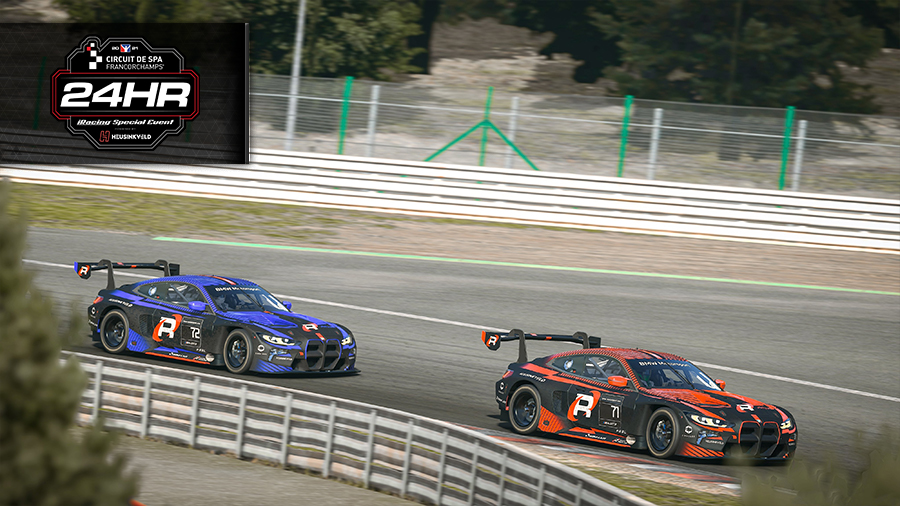
The detail that changes how you should approach this event: Spa is a single-class GT3 race. Daytona and the Nürburgring throw you into multi-class traffic with GTP and LMP2 cars closing at very different speeds. Spa does not. Everyone is in a GT3 car, everyone is on roughly the same lap time, and the field is seeded into splits by team iRating. The car coming up behind you wants your exact position. That makes the racing closer and the consequences of a clumsy defensive move more expensive.
If you want to understand how iRacing's split and ranking system works, our breakdown of iRacing's Safety Rating and iRating explained covers it in full.
The field is the full current GT3 grid, all under iRacing's Balance of Performance: the Aston Martin Vantage GT3 EVO, Audi R8 LMS EVO II GT3, BMW M4 GT3 EVO, Chevrolet Corvette Z06 GT3.R, Ferrari 296 GT3, Ford Mustang GT3, Acura NSX GT3 EVO 22, Lamborghini Huracán GT3 EVO, McLaren 720S GT3 EVO, Mercedes-AMG GT3 2020, and Porsche 911 GT3 R (992). For a full overview of what's new in iRacing's current season, see our iRacing Season 3 2026 guide.
Building Your Team and Logistics
You cannot solo this one. A team is 2 to 16 drivers, and the practical sweet spot for a 24-hour race is somewhere around three to five so nobody is driving six-hour blocks at 4am.
One person registers the team about an hour before the race opens and selects who's driving. Drivers can join and leave through the race, but if a registered teammate no-shows or the team breaks the fair-share rules, the whole entry gets disqualified. That's the entire team's result gone because of one logistics slip, which is why none of this can be improvised on race morning.
Fair share is simpler than most teams think. Each driver must complete at least one-quarter of an equal share of the race distance. A quick rule of thumb is: total laps ÷ number of drivers ÷ 4. Work it out before race day so nobody is scrambling for laps in the final hours.
Lock the boring stuff early. Agree a driver rotation, a comms channel (Discord, usually), who's running fuel and strategy calls, and a backup plan if someone drops offline. Our full walkthrough on how to prepare for an iRacing Special Event covers the team setup and registration mechanics step by step. Read it with your teammates, not alone.
Choosing a GT3 Car for Spa 24
Every car in the field is BoP'd to be competitive, so the fastest qualifying machine is rarely the smartest endurance pick. Over a single lap, peak pace matters. Over 24 hours, what matters is whether you can consistently lap within the car's limits and maintain a predictable pace as fuel loads change, tyres wear, and conditions evolve.
Pick for stability and tyre life over outright speed. A car that rotates on a knife edge will reward your fast laps and punish your tired ones, and you will spend more of this race tired than fast. Prioritise a front end you trust on turn-in to Les Combes and a rear that stays planted through the fast stuff, because Spa has a lot of fast stuff. If your team is already quick in a particular GT3 car from the road season, that familiarity is usually worth more than chasing whatever the current meta pick is.
Managing Pace, Fuel, and Tyres Over a Full Day
Know your fuel number before the race, not during it. Work out how many laps you get from a tank in the conditions you expect, then build your stint plan around that and practice lifting and coasting so you can stretch a stint when strategy calls for it. Spa is hard on front tyres thanks to all the long, loaded corners like Pouhon, so find out in practice whether your car can double-stint its tyres or whether the drop-off makes a change worth the pit time.
This is also where telemetry earns its keep. Comparing your stints against your quickest teammate, or against a reference lap, shows you exactly where the time is going when you start fading. Our guide on recording and reading your iRacing telemetry walks through how to turn that data into laptime, which matters more over a long race than any single setup tweak.
Driving Spa at Night and in Changing Weather
Spa-Francorchamps is challenging enough in perfect conditions, but iRacing’s dynamic weather and day-night transitions add an entirely new layer of complexity. A race that begins on a dry track can evolve into wet conditions hours later, forcing drivers to constantly adapt. Spa is famous for its unpredictable microclimates: one section of the circuit can be soaked while another remains completely dry.
The key is to prepare before the weather changes. Plan for it. Decide in advance who makes the wet-tyre call and at what point you'd rather lose 5 seconds a lap on slicks than risk a spin into Stavelot.
At night your braking references may disappear and you're driving more on feel than on sight. This is the moment a wheel that's been screaming at you all race becomes a liability, because you stop being able to separate useful information from noise. If you've ever finished a long stint with dead arms, you're probably one of the drivers running too much force feedback, and Spa at 4am is exactly when that costs you a corner.
Common Mistakes That End Spa 24 Races Early
Most retirements in this event are self-inflicted. A few patterns repeat every year.
The biggest one is overdriving the opening hour. Drivers treat lap one of a 24-hour race like a sprint qualifier, throw it into the wall at Raidillon trying to make a move that gains nothing, and end the team's race before the sun's gone down once. Race the first stint like you've got 23 hours left, because you do.
Skipping practice on pit stops and driver swaps is the next. Teams that have never rehearsed a stop lose 30 seconds fumbling the handover, or worse, send out a teammate who's never driven the car cold on slicks into a damp Pouhon. Run a practice session together and do real swaps before race day.
Plenty of teams also ignore fuel until the light comes on. Running dry on the Kemmel Straight is an embarrassing way to lose a lap, and five minutes of maths in practice removes the risk entirely. Then there's the hero divebomb into Les Combes in traffic. In a single-class field the car you're fighting is the same speed as you, so the all-or-nothing lunge that occasionally works against a slower class almost never sticks here. It just collects two cars.
Banking Your Spa 24 Result in Practice
The Spa 24 is won in the three weeks before July 10, not on the night. Get your team sorted, put in real stints at Spa until the lap is automatic and you can hit your fuel number in your sleep, rehearse your stops, and decide your wet-weather and night plans while you're calm. Do that and the race itself becomes the easy part: drive within yourself, keep it clean, and let the teams who didn't prepare hand you positions through attrition.
If you want a faster route through that practice, Mansell can coach you through your Spa stints, breaking down where you're losing time so you arrive at the green flag actually ready.
Written by the team at trophi.ai.
FAQs
FAQ
When is the iRacing Spa 24 Hours in 2026?
The iRacing Spa 24 Hours runs July 10–12, 2026 at Circuit de Spa-Francorchamps, across four time slots over the weekend. Check iRacing's Special Events page for the exact slot times in your timezone.
Do you need a team to enter the iRacing Spa 24?
Yes. It's a team event for 2 to 16 drivers, and one person registers the team roughly an hour before the race opens. You can join an existing team or build your own inside iRacing.
What cars are used in the iRacing Spa 24?
It's a single-class GT3 event using the full current GT3 field, all balanced under iRacing's BoP. That includes the BMW M4 GT3 EVO, Ferrari 296 GT3, Mercedes-AMG GT3, Porsche 911 GT3 R (992), Chevrolet Corvette Z06 GT3.R, and the rest of the GT3 grid.


