Train more people, faster, with the instructors and simulators you already have.
Kairos integrates with existing training and simulation environments to provide real-time coaching, feedback, and assessment, enabling more independent practice and faster progression toward competency for every trainee.
Demand for trained aircrew is outpacing the instructors available to train them.
Air forces and flight training organizations need to produce more aircrew, faster. But qualified instructors take years to develop, and their numbers can't grow at the pace demand requires. Trainees get less practice time than they need. Assessment standards vary from one instructor to the next. And when experienced instructors are reassigned or retire, their expertise leaves with them. The challenge is delivering more training, to a consistent standard, with the instructors and simulators already in place.
THE REAL BOTTLENECK
The simulator is not the constraint. The instructor is.
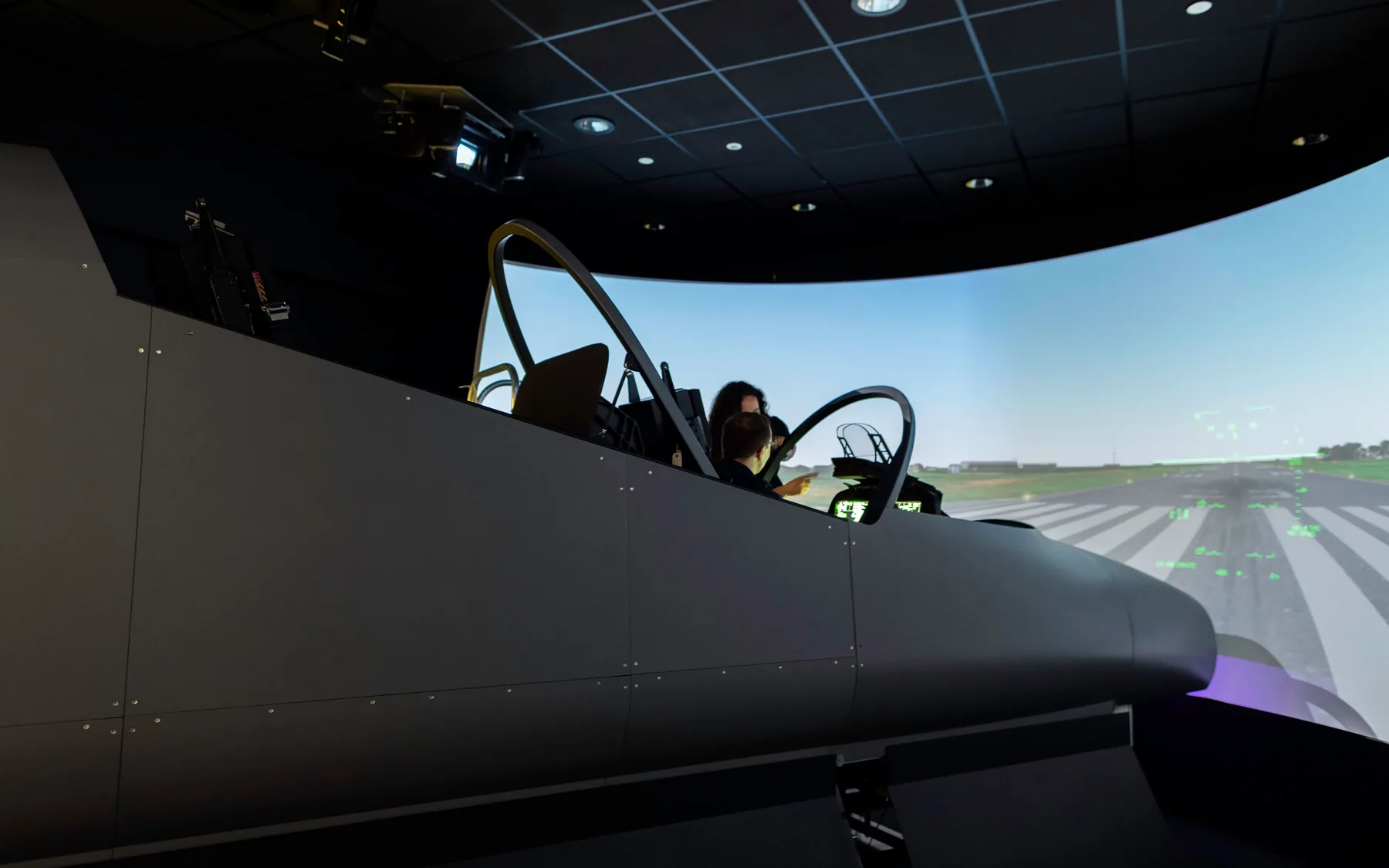
Kairos is what makes instructor judgment scale, so every hour in the simulator counts as instructed time.
Industry Signal
The economics already favor simulation-based training.
The remaining constraint is expert observation, instructional coverage, and standards review.
1,850
approximate USAF pilot shortfall
17:1
rough simulator cost advantage versus a live F-35 flight hour
IMPLEMENTATION CASES
How teams use Kairos in defence aviation.
These are concrete ways organizations can deploy the system. Each case shows where Kairos fits, what it sees, what it does, and what changes as a result.
01 / TRAINING SORTIE
Put an instructor beside every simulator session.
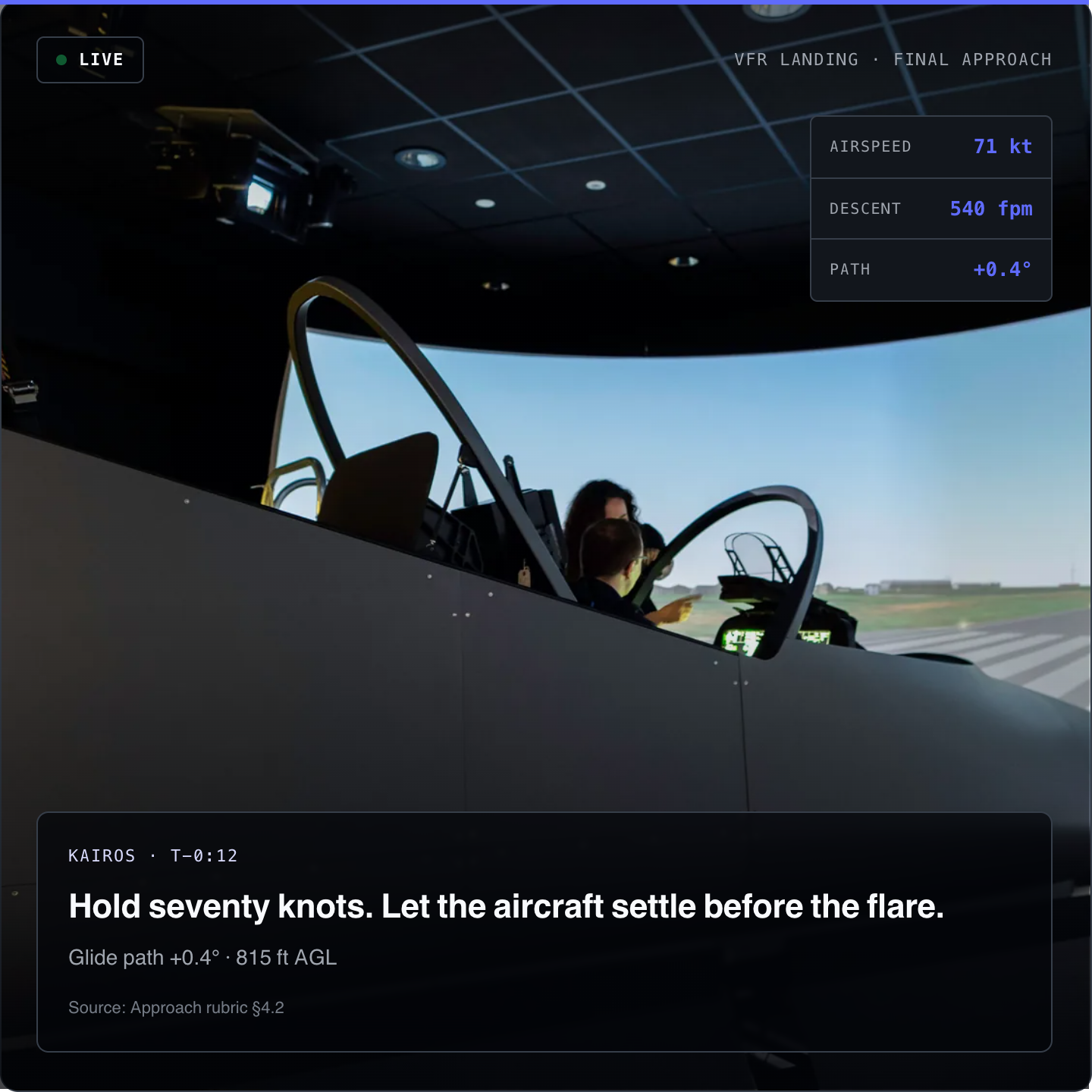
Kairos briefs the objective, watches the sortie, intervenes when the student drifts from the standard, and produces a debrief with root causes after landing.
What Kairos Sees
Session plan, telemetry, audio, learner history
What KAIROS does
Brief, live cues, debrief, cited feedback
What CHANGES
More instructed hours without one instructor per device
02 / STANDARDS CHECK
Evaluate the same skill with assistance off.
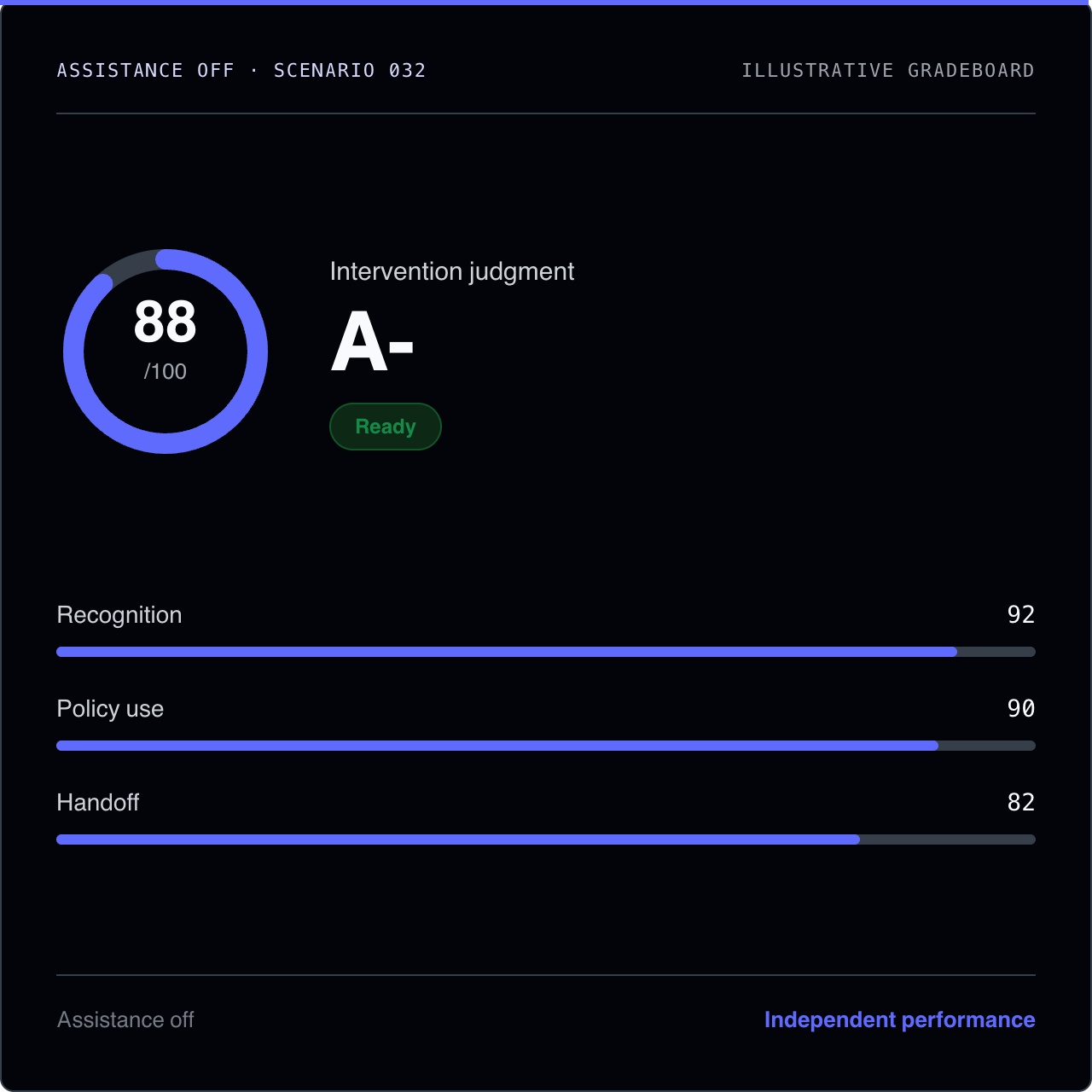
Once a skill is trained, Kairos can remove guidance and measure whether the student can execute independently against the approved rubric.
What Kairos Sees
Rubric, tolerances, maneuver definitions
What KAIROS does
Observe silently, score performance, flag misses
What CHANGES
Clear evidence of progression and readiness
03 / READINESS SUSTAINMENT
Keep rare procedures current between formal events.
Use targeted practice and debriefing to keep emergency procedures and weak areas current between instructor-led events.
What Kairos Sees
Recent performance history and weak-skill trends
What KAIROS does
Assign drills, coach execution, track recovery
What CHANGES
Readiness that decays less between checks
One performance. Three moments that matter.
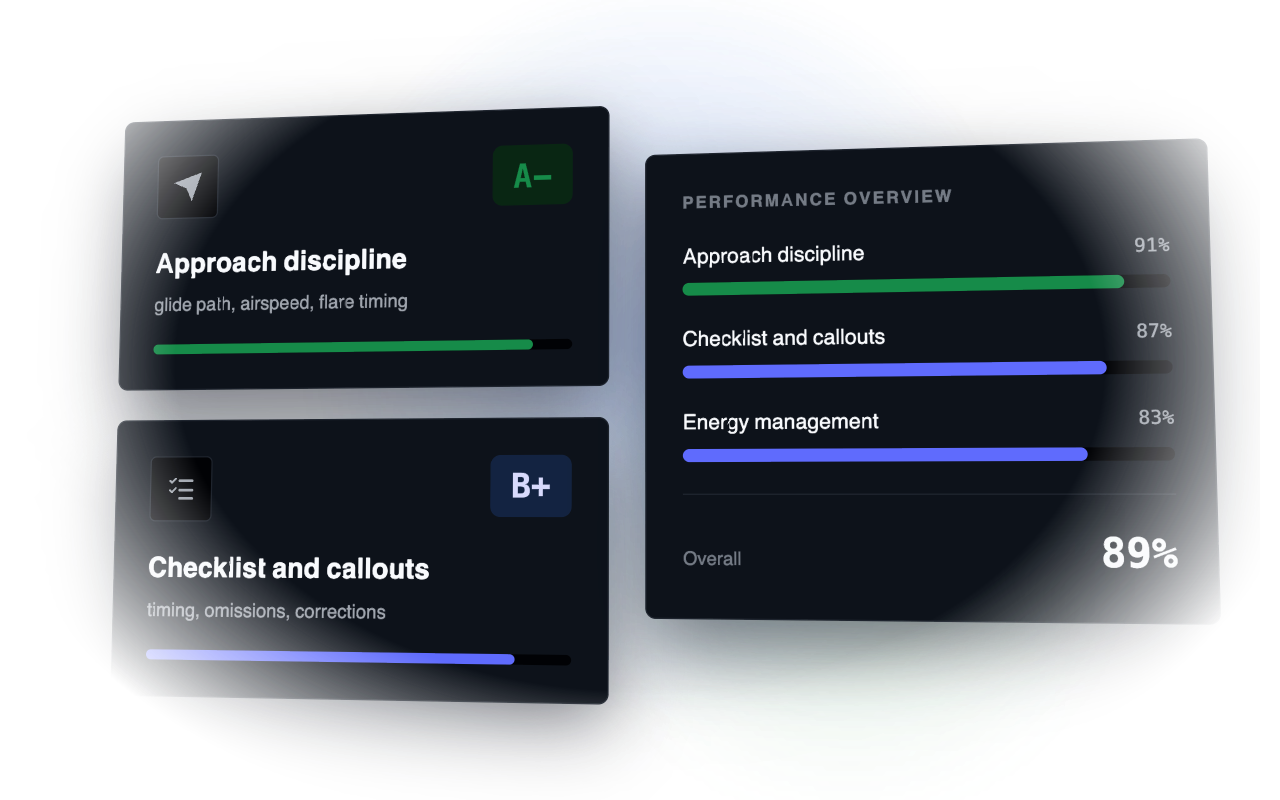
Kairos delivers the right kind of instruction at each stage: real-time guidance while the outcome can still change, independent evaluation when assistance is off, and a focused debrief tied to the exact moment performance broke down.
01 / INSTRUCT
Correct it while it still matters.
Kairos identifies the issue as it happens and delivers only the instruction needed in that moment.
02 / EVALUATE
Evaluate independent performance against the syllabus.
Turn assistance off and evaluate independent performance against the standards that define success.
03 / DEBRIEF
Go straight to the moment that mattered.
Kairos connects the performance issue to its likely cause, the next correction, and the source behind it.
BUILT FOR DEFENCE TRAINING
What makes Kairos work in real training environments.
01
One system across the full training cycle
Brief before the exercise, guide proactively in real time, debrief after it, and evaluate the same skill with assistance off.
02
Instruction grounded in your doctrine
Kairos works from approved manuals, procedures, curriculum, and rubrics, so instruction reflects the standards your organization already uses.
03
Deploy where the mission requires
Run Kairos on-premise, hybrid, or fully disconnected, including local inference where cloud access is unavailable or inappropriate.
04
Every intervention can be reviewed
Trace each cue back to the observed performance, the rule or standard behind it, and the source used to support the instruction.